-
English


In today’s stage design, visual impact matters more than ever. Audiences expect more than flat LED backdrops. As a result, kinetic LED screens have become a powerful solution for concerts, music festivals, and large-scale live events. Use mechanical rotating LED screens to boost your project
Unlike conventional LED displays, a kinetic LED screen combines movement, visuals, and sound into one dynamic system. Multiple LED modules move independently to create waves, peaks, reliefs, and sculptural forms. Instead of showing content on a flat surface, the screen itself becomes a living structure. This transformation allows stages to feel immersive, expressive, and unforgettable.
With the live entertainment industry growing rapidly, more designers now choose kinetic LED screens to create bold, attention-grabbing stages. Below, we explore how kinetic LED technology reshapes stage design and what to consider when choosing the right system.
First, kinetic LED screens remove the limits of traditional flat displays. Each LED module can lift, rotate, and slide independently. Designers can combine these movements in three-dimensional space to form mountains, waves, buildings, or abstract art.
As a result, the stage background no longer feels like a video wall. Instead, it becomes a flexible architectural structure that changes shape throughout the performance.
Next, kinetic LED screens bring music to life through motion. The system can move in real time, synchronized with rhythm and emotion.
For example, during a powerful chorus, the modules can rise sharply to form dramatic peaks. During a soft interlude, they can flatten into calm, flowing waves. In this way, the screen behaves like a mechanical dancer that reacts directly to sound.
Even without video content, kinetic LED screens create depth. Different module heights naturally build strong visual layers and perspective.
When designers add custom video content, the effect becomes even stronger. Viewers experience a glasses-free 3D illusion, with visuals that appear to extend forward or sink deep into the stage. This depth greatly increases immersion.
Kinetic LED screens also help create fully immersive environments. When motion, video, and projection align, the screen can simulate objects breaking through the display or generate the feeling of endless space.
This approach works especially well for large venues, where scale and atmosphere define the audience experience.
Another major advantage is interaction between performers and the screen. The moving modules can form stairs, platforms, arches, or tunnels.
Performers can walk on them, stand between them, or even appear from within the screen. For instance, a singer may rise from a lifted module, or dancers may weave through a shifting LED matrix. This creates a true fusion of human performance and digital structure.
Kinetic LED systems also support responsive triggers. Through programming and sensors, screen movement can react instantly to music beats, drum hits, or performer actions.
As a result, visuals become a physical extension of sound. This real-time interaction makes each performance feel alive and unique.
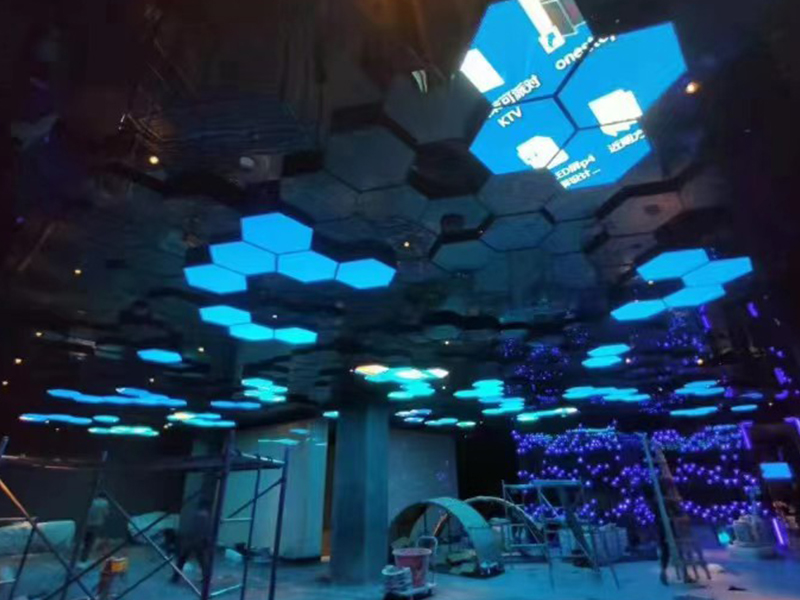
Every LED module acts as a light source. When these modules move, they create flowing light patterns that work alongside stage lighting systems.
In many cases, kinetic LED screens can replace or enhance traditional lighting, adding depth and motion that static fixtures cannot achieve.
Finally, kinetic LED screens allow rapid shape changes to match different themes. For a sci-fi performance, the screen can transform into a metallic grid. For a nature-inspired show, it can resemble a forest canopy or rolling terrain.
This flexibility helps designers reinforce storytelling without changing physical stage structures.
Reducing weight improves performance. Lighter screens place less load on motors, which leads to faster response times and smoother motion.
Compared to traditional aluminum cabinets, carbon fiber structures can reduce weight by 30%–50%. This reduction lowers rigging requirements and allows more modules to hang safely in the same space.
Transparent LED mesh screens offer additional advantages:
Touring productions demand speed and reliability. Lightweight kinetic LED screens often include patented quick-lock systems, allowing thousands of connection points to assemble within hours. This design supports fast setup and teardown during intense touring schedules.
1. What is a kinetic LED screen?
A kinetic LED screen is a dynamic display made of moving LED modules that change shape and position in real time, synchronized with music or performance.
2. Where are kinetic LED screens commonly used?
They are widely used in concerts, music festivals, theaters, brand shows, and large event stages where immersive visuals are essential.
3. Are kinetic LED screens suitable for outdoor stages?
Yes. With lightweight materials and transparent LED mesh designs, kinetic LED screens can perform safely and smoothly in outdoor and windy environments.
+86 18688923792
+86-755-23312336
4th Floor, Building B, Zhonghe Building, Taiwan Industrial Zone, 2132 Songbai Road, Shiyan Street, Bao'an District, Shenzhen.


Emall us with any questions or inquiries or use our contact data.We would be happy to answer your questions.
Toosen Professional Manufacturer of led sphere display,led screen globe,led ball display,spheric led screen,spherical led display, Led Special-shaped LED manufacturer, LED factory,Manufacturers & Suppliers,Factory & Exporters. Looking forward to your cooperation.
Copyright © 2010-2026 Toosen LED All Rights Reserved
Theme by WordPress