-
English


An LED letter screen may look sharp and bright during factory testing but appear much weaker after installation. The reason is often not the LED brightness itself. It is the lighting around the screen.
Ceiling lights, spotlights, glass walls and reflective floors can all change how dark the black areas appear. This reduces the visible contrast between illuminated pixels and the background.
For this reason, checking only the contrast ratio on a specification sheet is not enough. A better approach is to test the LED letter display under the actual lighting conditions of the venue.
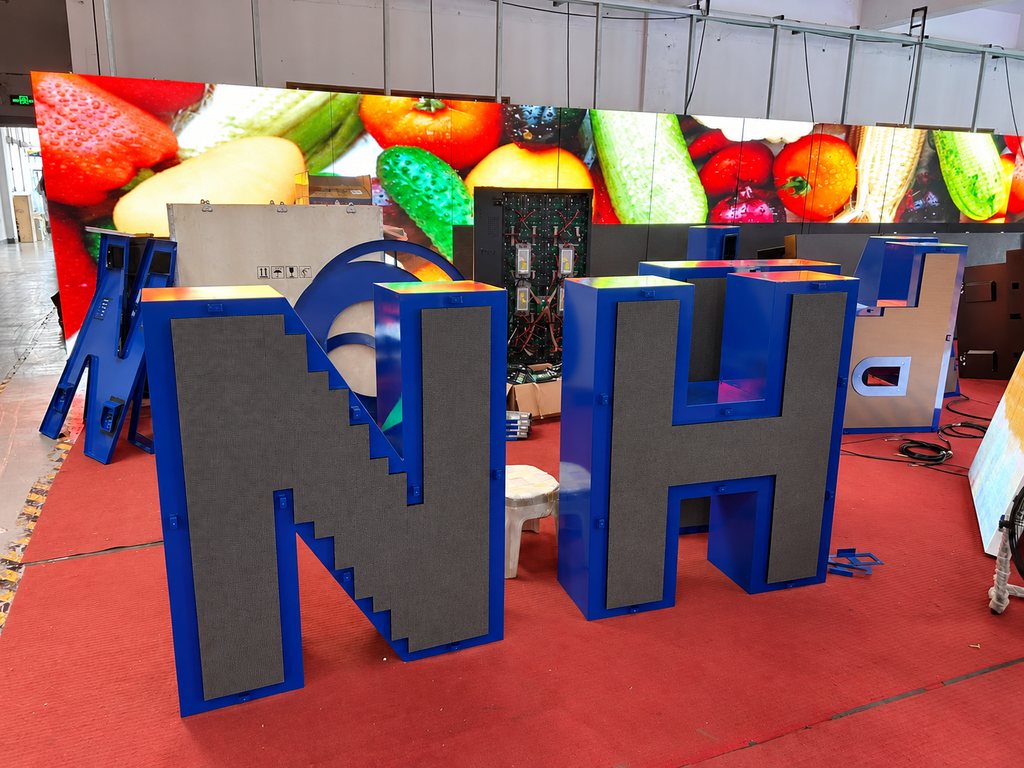
Contrast ratio normally describes the difference between the brightest white and the darkest black a display can produce.
In a controlled factory environment, surrounding light can be reduced. The black surface of the LED module therefore looks very dark.
A real venue is different.
An LED letter screen may be installed below strong ceiling lights, next to a glass entrance or close to illuminated advertising panels. Light can reflect from the LED mask and module surface.
The black area then appears gray instead of black.
This means a screen with a good laboratory contrast ratio may still have poor visible contrast after installation.
The problem can be more obvious on an LED letter display because the screen does not form one large rectangle. Each character contains narrow strokes, curves, gaps and exposed edges.
Before adjusting LED brightness, first measure the ambient light around the installation position.
A lux meter is useful for this step.
Do not record only one lux value. Test several operating conditions, such as:
The test should be made close to the LED screen surface and from the main audience area.
For outdoor-facing windows or entrance areas, it is also useful to test at different times of day because daylight may change significantly.
Two locations can both measure 800 lux but still produce very different LED screen contrast.
For example, one light source may shine from the ceiling, while another spotlight may point directly toward the LED surface.
Direct light can create stronger reflections.
This is why the test record should include both the ambient lux level and the direction of the main light source.
If a spotlight is aimed directly at the LED letters, changing the spotlight angle may sometimes improve readability more effectively than simply increasing screen brightness.
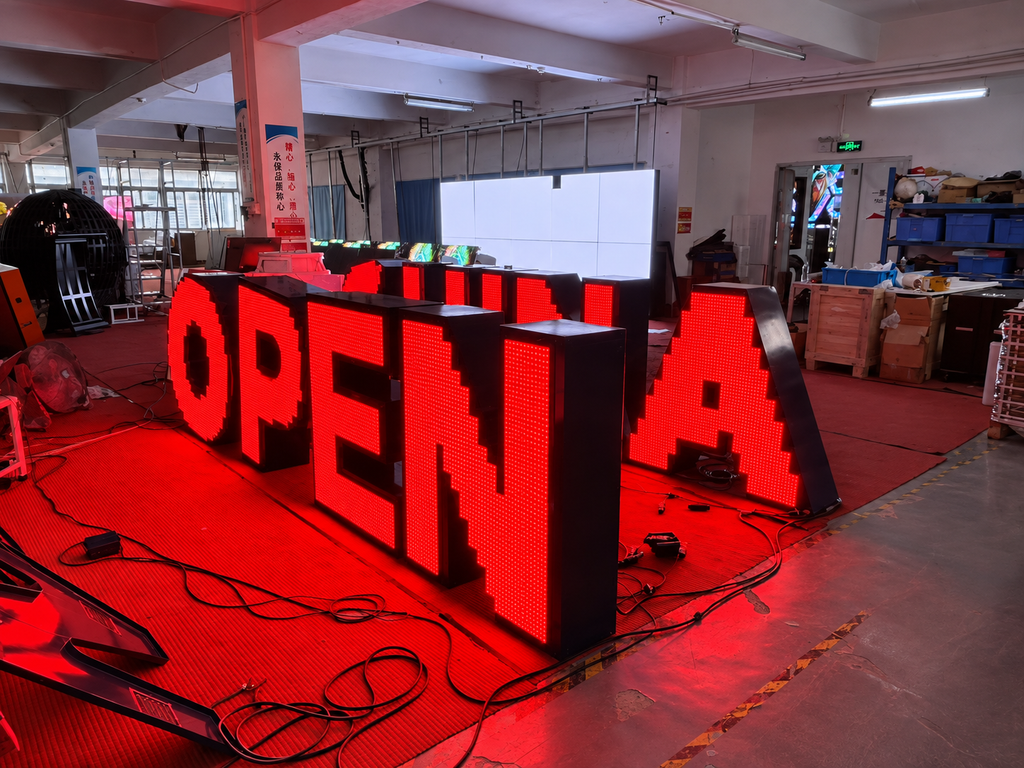
Do not judge contrast only by playing colorful advertising videos.
Video content can hide problems because constant movement and bright colors make the screen look more impressive.
Instead, prepare several simple test patterns:
Full white: checks maximum visible brightness.
Full black: shows how much ambient light is reflected by the LED surface.
White letters on black: tests normal text readability.
Dark gray content: reveals weak contrast that may not be obvious with bright video.
Testing simple content makes it easier to compare different brightness settings and lighting conditions.
This is one of the most important differences between a normal rectangular LED display and an LED letter screen.
A wide part of a letter may look clear while a narrow stroke loses definition.
For example, characters such as E, A, M or S contain different widths, corners and curves.
During testing, do not measure only the largest part of the screen.
Check:
If these areas remain readable under venue lighting, the whole LED letter design is more likely to perform consistently.
A technician standing directly in front of the screen may see excellent contrast.
The customer may not.
LED letter displays are often installed above entrances, reception desks, exhibition booths or retail walls. Viewers may see them from below or from one side.
Therefore, test from the main viewing positions.
For example:
Front view: confirms basic contrast.
30° left and right: checks side visibility.
Normal viewing distance: confirms whether individual strokes remain clear.
Closest expected distance: checks pixel and module consistency.
You should also check the screen from seated and standing positions if the installation is inside a public venue.
When contrast looks weak, increasing brightness is the most common reaction.
Sometimes it works.
But brightness should not be treated as the only solution.
If the LED surface reflects too much ambient light, increasing brightness may create excessive glare while the black areas still look gray.
Other factors should also be checked:
A balanced system normally gives better results than simply operating the screen at maximum brightness.
Factory testing is still important.
Before shipment, the manufacturer can test LED modules for brightness, color consistency, low-gray performance and basic contrast.
However, the final acceptance test should be completed after installation.
A useful record should include:
Ambient light: ___ lux
LED brightness: ___%
Viewing distance: ___ m
Viewing angle: ___°
Test content: white / black / gray / video
Result: pass / adjustment required
This creates a repeatable test instead of depending only on visual impressions.
Consider an LED letter display installed behind a shopping mall reception area.
During factory testing, the letters look clear.
After installation, several ceiling spotlights shine toward the display. The LED letters remain bright, but the black background around the pixels begins to reflect light.
Instead of immediately increasing LED output, the installation team adjusts the spotlight angle and slightly changes the LED brightness.
The letter edges become clearer and the display produces better visual contrast without unnecessary glare.
This is why installation lighting should be treated as part of the LED display system.
There is no single number that guarantees good performance in every venue. Ambient light, LED surface reflection, brightness and viewing distance all affect the final result.
No. Excessive brightness can cause glare and may shorten component life. Brightness should match the actual installation environment.
You can use them as part of the final check, but black, white and low-gray test patterns are better for identifying contrast problems.
The most useful test is after the LED letter screen and venue lighting have both been installed and adjusted.
Toosled provides custom LED display solutions for different shapes, dimensions and installation environments.
For an LED letter screen project, factors such as pixel pitch, letter stroke width, viewing distance, module structure, installation position and venue lighting should be considered together.
Before production, providing the letter design, installation dimensions, viewing distance and lighting environment can help the engineering team evaluate whether the selected LED configuration is suitable for the real application.
For more custom LED display solutions, visit https://www.toosled.com/.
+86 18688923792
+86-755-23312336
4th Floor, Building B, Zhonghe Building, Taiwan Industrial Zone, 2132 Songbai Road, Shiyan Street, Bao'an District, Shenzhen.


Emall us with any questions or inquiries or use our contact data.We would be happy to answer your questions.
Toosen Professional Manufacturer of led sphere display,led screen globe,led ball display,spheric led screen,spherical led display, Led Special-shaped LED manufacturer, LED factory,Manufacturers & Suppliers,Factory & Exporters. Looking forward to your cooperation.
Copyright © 2010-2026 Toosen LED All Rights Reserved
Theme by WordPress