-
English


A flexible LED display can pass a waterproof test in the factory and still develop water inside the structure after installation.
At first, this sounds contradictory.
If the display passed the water test, how can water remain inside?
The reason is simple: keeping rain from entering and allowing moisture to leave are two different engineering problems.
A waterproof test mainly checks whether water can penetrate certain protected areas under specific test conditions. It does not always show what happens after rain, temperature changes, long operating hours or repeated heating and cooling.
For an outdoor flexible LED display, a good waterproof design must consider not only sealing, but also drainage, ventilation and the final installation structure.
Many people treat waterproofing as one simple question:
“Can water get through the LED module?”
But a complete flexible LED screen contains much more than the front LED surface.
Behind the modules there may be:
Water or moisture can collect in these areas even when the LED module itself remains protected.
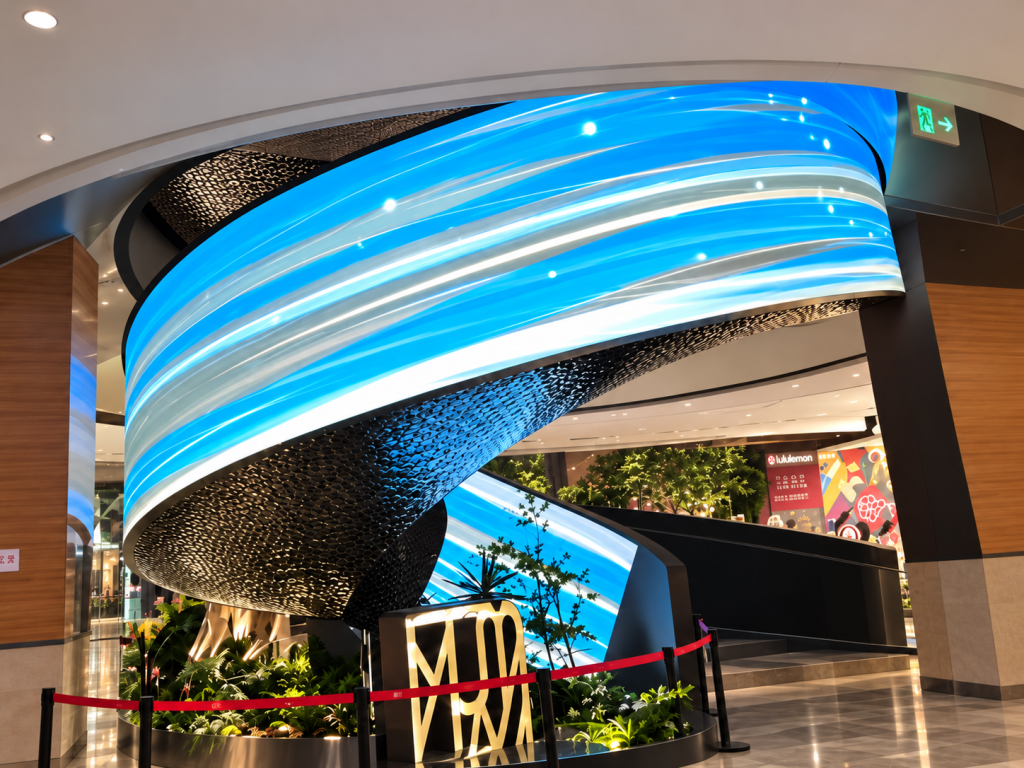
This is especially important with a flexible LED display, because the screen may be installed around columns, curved walls or irregular metal frames. These structures create more corners, channels and low points where water can stay.
A factory waterproof test may focus mainly on the LED module or assembled screen surface.
After installation, however, the complete system contains additional openings.
Cable entry holes are a common example.
Power and signal cables may pass through the rear structure. If the connector or cable opening is not correctly sealed, rainwater can move along the cable and enter the internal frame.
Water does not need a large opening.
A small gap around a connector, screw hole or structural joint can become an entry path during heavy rain.
The screen itself may therefore pass its waterproof test while the installed structure still allows water to enter.
Sometimes there is no external leak at all.
Water forms inside the structure because of condensation.
An outdoor LED screen heats up during operation. After the screen is switched off, or when the outdoor temperature drops at night, the air inside the structure begins to cool.
Warm air can hold more moisture than cool air.
When humid air reaches a colder metal surface, part of that moisture can become small water droplets.
This means a technician may open the display and find moisture even though rainwater never passed directly through the LED module.
In humid or coastal environments, this problem can become more obvious.
That is why simply adding more sealant is not always the correct solution.
A completely closed cavity with poor moisture control may actually make trapped humidity harder to remove.
Waterproofing should not only stop water.
The structure must also answer another question:
If a small amount of water reaches the inside, where will it go?
This is where drainage design becomes important.
Imagine a curved flexible LED display installed around a column.
The modules may be protected, but the metal frame behind them can create several horizontal channels. Rainwater or condensation may move downward until it reaches one of these channels.
If there is no drainage opening at the lowest point, the water stays there.
The problem becomes worse when the frame contains several independent cavities.
One drainage hole at the bottom of the complete display may not help if water is trapped inside a higher closed section.
Good custom LED display design therefore needs to consider the actual movement of water through the entire structure.
This problem is particularly important for flexible LED screens.
A drainage design that works when the structure is flat may not work after the screen is bent.
For example, a drainage opening may originally be located near the lower edge of a frame.
After the frame is curved or installed at an angle, another part of the structure may become the true lowest point.
Water will naturally move there instead.
If that area has no outlet, a small internal pool can form.
This is why drainage should be evaluated using the final installation angle and shape, not only from a flat engineering drawing.
Sealant is important for outdoor LED installations, but more sealant does not automatically mean better waterproofing.
During installation, technicians sometimes seal almost every visible opening because they want to prevent rainwater from entering.
However, an opening designed for drainage or pressure equalization may also be blocked accidentally.
Now water has fewer ways to escape.
This creates an unusual situation:
the installer improves one part of the waterproof system while damaging another.
Sealant should therefore follow the structural design rather than being added randomly around the frame.
A useful waterproof inspection should go beyond spraying water onto the front surface.
The team should test the display in the same orientation in which it will finally operate.
After the water test, technicians should open selected rear sections and check:
The screen can also be operated before and after the test to create realistic temperature changes.
This helps reveal problems caused by both external water and internal condensation.
For custom projects, drainage should be checked before mass production because changing drainage channels after the complete structure is installed can be difficult.
Consider an outdoor curved flexible LED display installed around a building column.
The LED modules pass the factory water-spray test.
After installation, the screen also works normally during the first rain.
Several weeks later, technicians notice corrosion near a connector in the lower section.
The problem is not necessarily a failed waterproof module.
Water may have entered through a rear cable opening, moved downward along the internal frame and collected in a structural pocket.
Because there was no drainage hole at that exact low point, the connector remained in a humid environment for days.
The better solution is not simply replacing the LED module.
The cable entrance, internal drainage route and frame geometry all need to be checked.
Yes. An IP rating describes a defined level of protection, but the complete installed display also includes frames, cable openings, connectors and other structural areas.
The exact design depends on the project, but outdoor structures should have a planned way for accumulated water or condensation to leave safely.
Not necessarily. Silicone can seal unwanted gaps, but it should not block drainage or ventilation paths.
Because curved and irregular structures create changing angles, cavities and low points. The final shape affects where water naturally collects.
A reliable outdoor flexible LED display needs more than a waterproof LED module.
Module sealing, cable protection, connectors, structural joints, drainage routes and installation angles must work together.
A screen can pass a water-spray test and still fail later if moisture has nowhere to escape.
That is why the better engineering question is not only:
“Can we stop water from entering?”
It is also:
“If moisture appears inside, how quickly can it leave?”
Toosen provides customized shaped LED display solutions for indoor and outdoor projects, including curved and irregular structures. Outdoor configurations are available with IP65 protection, while the structure, installation method and supporting system can be customized according to the project environment.
For projects involving unusual curves or complex outdoor structures, reviewing drainage and waterproofing together during the design stage can prevent much more difficult maintenance after installation.
+86 18688923792
+86-755-23312336
4th Floor, Building B, Zhonghe Building, Taiwan Industrial Zone, 2132 Songbai Road, Shiyan Street, Bao'an District, Shenzhen.


Emall us with any questions or inquiries or use our contact data.We would be happy to answer your questions.
Toosen Professional Manufacturer of led sphere display,led screen globe,led ball display,spheric led screen,spherical led display, Led Special-shaped LED manufacturer, LED factory,Manufacturers & Suppliers,Factory & Exporters. Looking forward to your cooperation.
Copyright © 2010-2026 Toosen LED All Rights Reserved
Theme by WordPress