-
English


Trade shows are busy places. Visitors walk past hundreds of booths, and exhibitors often have only a few seconds to catch their attention. A standard LED screen can show videos and product information, but a moving display can create a different experience.
A mechanical rotating LED screen combines LED panels with a motor-driven system to create movement. Depending on the design, the display can rotate, slide, or move individual sections to create changing shapes.
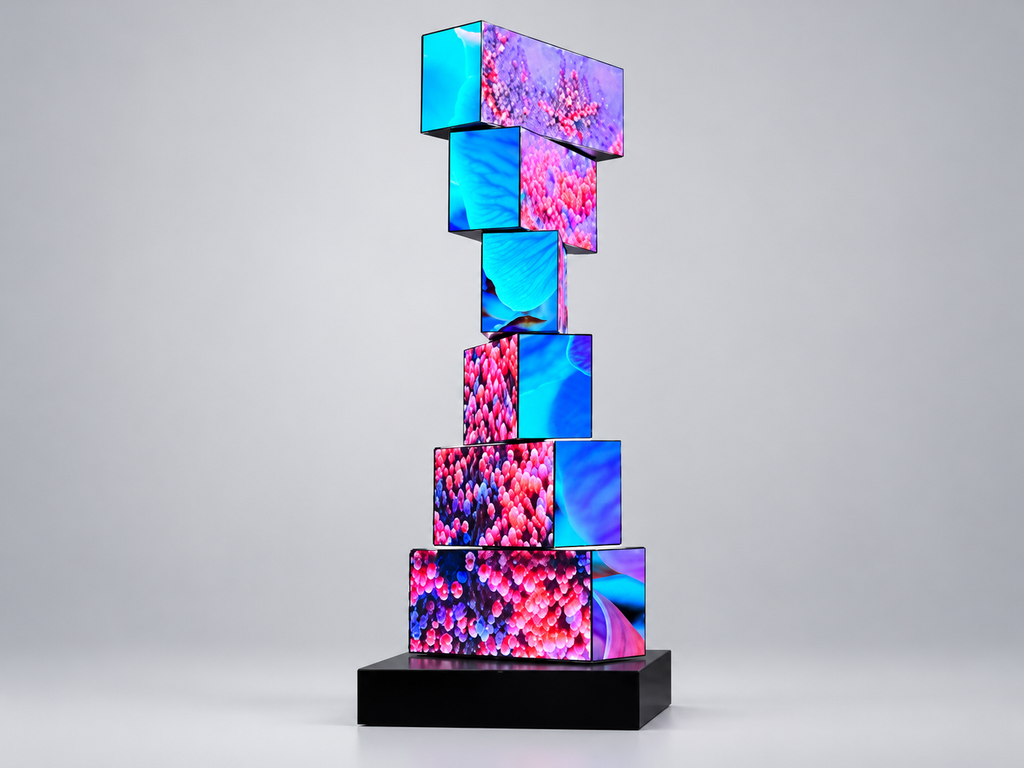
However, choosing the right system involves more than screen size and image quality. You also need to consider the booth layout, mechanical structure, installation space, and how the screen will operate during the event.
Before choosing a mechanical LED display, think about what you want visitors to see.
For a product launch, a moving screen can reveal a new product or create a short visual show. In a large exhibition booth, it can become the main attraction above the product display area.
Common applications include:
The design should match the purpose of your booth. A small display may work well for close viewing, while a larger moving LED wall may be better for an open exhibition area.
It is also worth considering how often the screen needs to move. Some projects only require a short movement sequence every few minutes. Others need continuous motion during a presentation.
Screen size depends on the available space and how far visitors will stand from the display.
For indoor trade shows, visitors may view the screen from only a few meters away. A smaller pixel pitch can help display detailed images and text clearly.
TOOSLED offers mechanical LED display options with pixel pitches such as P1.2, P1.5, P1.9, and P2.5.
Before choosing a model, consider:
Do not choose the smallest pixel pitch automatically. For many projects, a suitable viewing distance and a well-designed display layout matter more than having the highest possible resolution.
A moving LED screen needs a properly designed support structure.
Unlike a fixed display, a mechanical system creates additional forces when it starts, stops, or changes direction. The weight of the LED modules, motors, frames, and cables must all be considered.
Before installation, ask the supplier for the total system weight and mounting requirements.
If the display will be suspended above a booth, the exhibition organizer may require structural calculations and approval from a qualified professional.
For a floor-mounted system, check whether the booth platform can support the equipment and whether additional support frames are needed.
The installation should also leave enough space for moving parts, cable routing, and maintenance.
Never assume that a structure designed for a regular LED wall can safely support a moving display without further checks.
The control system is an important part of a mechanical LED display.
For example, a kinetic LED matrix can use individual moving modules to create wave patterns or three-dimensional visual effects. The movement needs to match the video content so the complete display looks natural.
TOOSLED’s mechanical matrix display uses programmable motion control and a motor-driven system. Its modular design allows different movement patterns to be created for exhibition projects.
When discussing the control system with a supplier, ask:
It is also useful to request a test video showing the actual movement you want.
A successful installation depends on both the LED image and the mechanical movement working together.
Trade show installation schedules are often tight. Exhibitors may have limited time to build their booths before the venue opens.
A modular system can make transportation and assembly easier, but the installation process still needs careful planning.
Ask the manufacturer how the modules connect, how cables are arranged, and which parts can be replaced on-site.
Safety should be part of the initial design. Moving LED equipment should have suitable travel limits, emergency stopping arrangements, and protection against unexpected movement.
The supplier and installation team should also confirm the necessary clearance around moving parts.
Before the exhibition opens, the complete system should be tested with the actual video and motion sequences.
Before requesting a quotation, prepare the basic information about your project.
| Item | Information to Provide |
|---|---|
| Exhibition location | Country, city, and venue |
| Screen dimensions | Required width and height |
| Installation method | Floor-mounted, wall-mounted, or suspended |
| Viewing distance | Approximate distance from visitors |
| Motion effect | Rotation, sliding, or moving matrix |
| Event schedule | Installation date and operating period |
| Video content | Resolution and required motion sequence |
You should also ask about packaging, spare parts, technical support, and the documents required for installation.
Providing this information early helps the manufacturer recommend a more suitable system and prepare a clearer quotation.
Mechanical LED displays are different from standard rental LED walls. Each project may require adjustments to the screen size, mechanical structure, and movement program.
That is why communication with the manufacturer matters.
Before placing an order, review product videos, available specifications, and similar installation examples. Discuss any limits involving movement, maintenance access, or transportation.
TOOSLED provides modular mechanical LED display solutions for exhibitions and creative installations.
You can explore the available designs and technical information on the Mechanical Rotating LED Screen
Choosing a mechanical rotating LED screen for a trade show starts with a clear project plan.
Screen resolution is important, but mechanical safety, installation conditions, motion control, and maintenance are just as important.
By confirming these details before ordering, you can avoid unnecessary changes during installation and choose a display that fits your booth design.
If you are planning a custom moving LED display, share your booth dimensions, installation method, and preferred motion effects with TOOSLED to discuss a suitable solution.
+86 18688923792
+86-755-23312336
4th Floor, Building B, Zhonghe Building, Taiwan Industrial Zone, 2132 Songbai Road, Shiyan Street, Bao'an District, Shenzhen.


Emall us with any questions or inquiries or use our contact data.We would be happy to answer your questions.
Toosen Professional Manufacturer of led sphere display,led screen globe,led ball display,spheric led screen,spherical led display, Led Special-shaped LED manufacturer, LED factory,Manufacturers & Suppliers,Factory & Exporters. Looking forward to your cooperation.
Copyright © 2010-2026 Toosen LED All Rights Reserved
Theme by WordPress