-
English


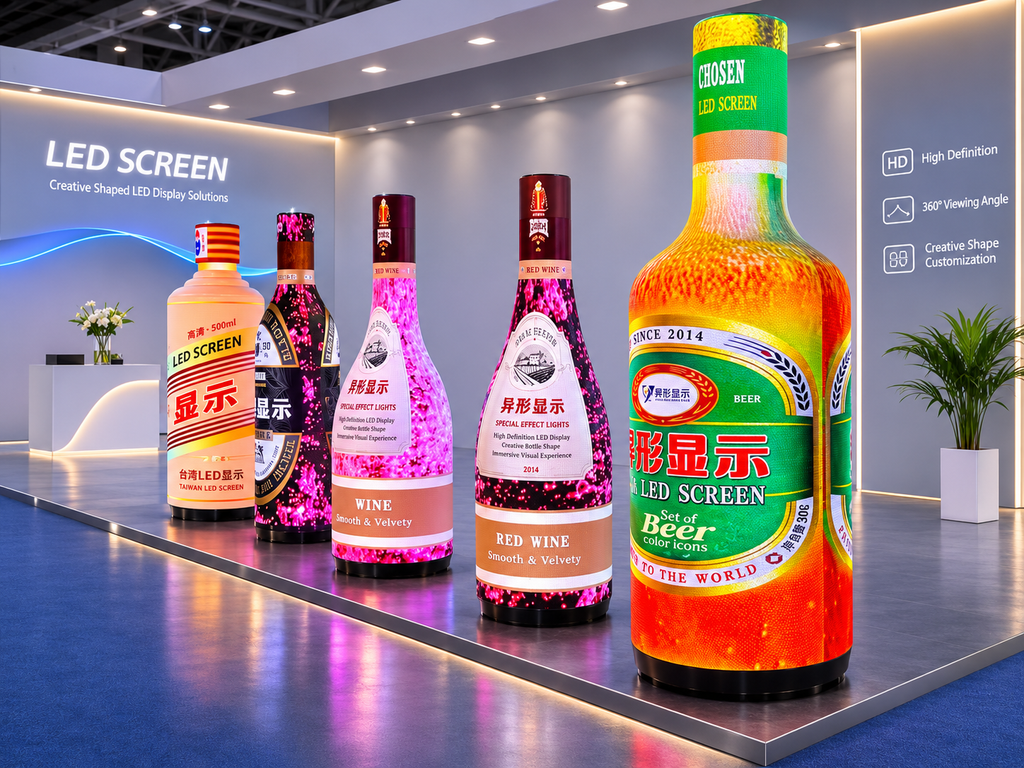
A bottled-shaped LED display is designed to attract attention through its unique appearance. It may feature a wide body, a narrow neck, rounded shoulders, and a specially designed base. These different sections create a distinctive visual effect in shopping malls, exhibitions, retail stores, and brand promotion spaces.
However, buyers should consider more than appearance and image quality. Maintenance access is another important factor.
Unlike a standard flat LED screen, a bottled-shaped LED display has a three-dimensional structure. Some internal components may be difficult to reach after the display has been installed. If the maintenance method is not properly planned, even a simple module replacement can become a time-consuming job.
Two common options are front-service and rear-service designs. Understanding their differences before ordering can help buyers avoid unnecessary installation costs and future maintenance problems.
Front-service LED displays allow technicians to access LED modules from the viewing side. Depending on the cabinet design, magnetic connections, locking mechanisms, or specialized tools can be used to remove individual modules.
This approach is useful when the bottled-shaped screen is installed against a wall, inside a decorative structure, or in a location with limited rear access.
Main advantages include:
However, front service also has limitations. Technicians need enough working space in front of the display to remove modules safely. The extraction direction must also be considered when designing curved shoulders, narrow neck sections, and other irregular areas.
Buyers should confirm whether the power supply and receiving card can also be accessed from the front. A display described as front-service does not automatically mean every internal component can be replaced from the viewing side.
Rear-service LED displays are maintained from the back of the cabinet or supporting structure. Technicians can open rear access panels to inspect power supplies, receiving cards, signal cables, and other electrical components.
This design is suitable for freestanding bottled-shaped LED displays where the rear structure remains accessible.
Its main advantages include:
Rear service is particularly practical for large installations with a dedicated maintenance area.
However, the supporting frame must provide enough space for technicians to work. If the display is positioned too close to a wall or surrounded by decorative panels, rear access may become difficult.
Another point to consider is that the rear maintenance structure should not interfere with the bottle’s external appearance or reduce the stability of the supporting frame.
Choosing between the two maintenance methods should be based on the actual project rather than price alone.
1. Installation Position
First, check where the display will be installed.
If the screen is mounted against a wall or integrated into a fixed decorative structure, front service may be more practical. For a freestanding installation with sufficient rear clearance, rear service may offer easier access to internal components.
2. Module Removal Direction
A bottled-shaped LED display usually contains different structural sections.
The main body, shoulder, neck, and base may require different module arrangements. Ask the manufacturer to provide a maintenance drawing showing how each section can be removed.
Pay special attention to modules near curved transitions, where surrounding structures may restrict access.
3. Access to Electrical Components
LED modules are not the only components that need maintenance.
Check how technicians can reach the power supply, receiving card, distribution board, and signal connections.
A design that allows easy module replacement but makes power supply replacement difficult may increase future repair time.
4. Cable Routing and Heat Dissipation
Custom-shaped displays often have limited internal space.
The power and signal cables should be arranged neatly without excessive bending, compression, or interference with removable modules.
There should also be a suitable heat dissipation arrangement. Technicians should be able to inspect internal components without completely dismantling the decorative structure.
5. Replacement Time and Spare Parts
Ask the manufacturer to demonstrate the actual replacement process.
Check how long it takes to remove a damaged module, reconnect it, and restore normal playback. Also confirm whether spare modules, power supplies, and receiving cards can be supplied for future maintenance.
A maintenance method should be verified through a practical test, not just a product specification.
Before shipment, buyers can request the following checks:
The most important step is to test the actual bottled-shaped structure rather than relying on a sample from a standard flat LED cabinet.
A customized bottled-shaped LED display generally includes LED modules, a supporting metal frame, power supplies, receiving cards, signal cables, and a control system.
The curved body and narrower upper sections require careful coordination between the mechanical structure and module layout.
The maintenance design should be considered during the initial engineering stage. Changing from front service to rear service after manufacturing may require adjustments to the frame, cable routing, and internal component positions.
Depending on the project, buyers can also discuss pixel pitch, screen dimensions, brightness, refresh rate, installation method, and environmental protection requirements.
Bottled-shaped LED displays are suitable for beverage brands, shopping malls, product exhibitions, retail promotions, and themed commercial spaces.
For example, a beverage brand may install a large bottle-shaped screen in a shopping mall entrance. If the screen is surrounded by decorative walls, front service can make future module replacement more convenient.
For an independent promotional display placed in an exhibition hall, rear service may be a better option if technicians can easily access the supporting structure.
The correct choice depends on installation conditions, maintenance frequency, available space, and the complexity of the display structure.
Q1. Which is better for a bottled-shaped LED display, front service or rear service?
Neither option is always better. Front service is suitable for installations with limited rear access, while rear service works well when the display has an accessible supporting structure.
Q2. Can a bottled-shaped LED display support both front and rear maintenance?
Depending on the structural design, a customized display may support different access arrangements. Buyers should confirm the available maintenance options with the manufacturer before production.
Q3. Does front service make LED display maintenance easier?
It makes front-side module replacement more convenient, especially in restricted spaces. However, access to power supplies and control components must also be checked.
Q4. What spare parts should buyers prepare?
Common spare parts include LED modules, power supplies, receiving cards, power cables, and signal cables. The exact list should depend on the display configuration.
Q5. Should maintenance access be confirmed before production?
Yes. Maintenance access affects the supporting frame, module arrangement, cable routing, and internal component positions. Confirming it early helps avoid costly structural changes later.
TOOSEN specializes in customized LED display solutions for different commercial and architectural applications. From product dimensions and pixel pitch to structural design and maintenance arrangements, each project can be planned according to its installation environment and operating requirements.
For bottled-shaped LED display projects, our team considers both the visual design and the practical needs of long-term operation. Buyers can discuss front-service or rear-service configurations, module replacement, supporting structures, and electrical layouts before production.
Choosing the right maintenance design from the beginning helps reduce future repair difficulties and makes the entire display project easier to manage.
Contact TOOSEN to discuss your bottled-shaped LED display project and find a maintenance solution that fits your installation requirements.
+86 18688923792
+86-755-23312336
4th Floor, Building B, Zhonghe Building, Taiwan Industrial Zone, 2132 Songbai Road, Shiyan Street, Bao'an District, Shenzhen.


Emall us with any questions or inquiries or use our contact data.We would be happy to answer your questions.
Toosen Professional Manufacturer of led sphere display,led screen globe,led ball display,spheric led screen,spherical led display, Led Special-shaped LED manufacturer, LED factory,Manufacturers & Suppliers,Factory & Exporters. Looking forward to your cooperation.
Copyright © 2010-2026 Toosen LED All Rights Reserved
Theme by WordPress