-
English


Wine bottle LED displays are one of the most eye-catching types of creative LED installations used in retail stores, bars, shopping malls, exhibitions, and brand events. Unlike traditional flat LED screens, these displays combine curved structures, flexible LED modules, custom steel frameworks, and 3D video mapping technology to create a realistic bottle-shaped visual experience.
This article explains how a bottle-shaped LED screen is designed, manufactured, assembled, and calibrated.
The production process starts with the exterior design of the bottle. Engineers first determine the exact dimensions and curvature of the display, including:
After confirming the shape, the team creates a detailed 3D model. This model helps define the structure, module layout, pixel arrangement, and installation method.
To reduce unnecessary customization costs, manufacturers usually combine different module types:
This approach improves production efficiency while keeping the bottle surface smooth and visually seamless.
Because the display has a large curved structure, a custom steel framework is required to support the screen safely and accurately.
The framework typically includes:
Most manufacturers use galvanized square tubes or round steel pipes to improve corrosion resistance and long-term durability.
For outdoor installations, engineers also perform structural simulations to calculate:
To ensure the curved surface remains smooth, the assembly tolerance is usually controlled within ±0.5 mm.
The bottle body is normally built using flexible LED modules with soft PCB materials. These modules can bend around curved surfaces with a bending radius of approximately R≥200 mm.
The modules are commonly attached to the steel structure through magnetic mounting systems, making installation and maintenance easier.
The bottle neck has a tapered shape, so standard rectangular modules cannot fit perfectly. Manufacturers therefore use:
These specially shaped modules allow the narrow upper section of the bottle to maintain smooth visual continuity without visible gaps.
Depending on the installation environment, the protection level can vary:
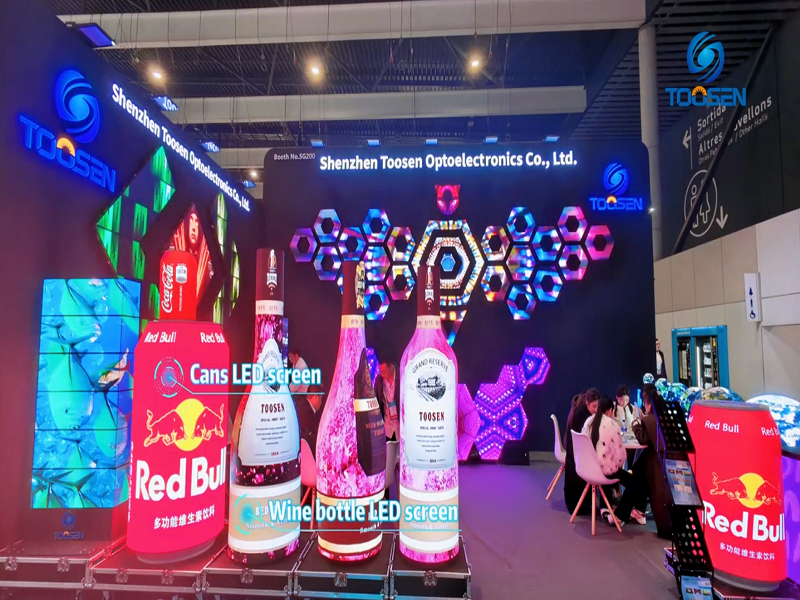
A wine bottle LED display requires a stable and intelligent control system to ensure smooth playback on its irregular surface.
The display typically uses DC power supplies with grouped and segmented power distribution. This method improves electrical stability and simplifies maintenance.
High refresh-rate driver ICs such as MBI5359 are often used to achieve:
Professional LED control systems from brands such as NovaStar or Colorlight are commonly used.
The system includes:
These tools make it possible to perform accurate 3D pixel mapping across the curved bottle surface.
Installation usually begins from the bottom:
Technicians use laser alignment tools to ensure accurate verticality and roundness.
The LED modules are installed from bottom to top:
The gap between modules is typically controlled below 0.5 mm to achieve a seamless visual effect.
Power cables and signal cables are carefully organized and hidden inside the structure to maintain a clean appearance and stable operation.
Before delivery, the display undergoes a full aging and testing process.
The screen is powered on continuously for at least two hours to test:
After hardware testing, technicians perform irregular-shape video mapping calibration.
Using specialized software, standard 2D video content is mapped onto the 3D bottle surface. Engineers then adjust:
This ensures that graphics, logos, and videos appear natural and undistorted on the curved bottle display.
Bottle-shaped LED displays combine creative design with immersive digital advertising. They are widely used for:
Compared with traditional flat screens, creative LED bottle displays attract more attention and deliver stronger visual impact, making them highly effective for brand marketing and customer engagement.
A wine bottle shaped LED screen is far more than a simple curved display. It combines industrial design, structural engineering, flexible LED technology, custom module manufacturing, and advanced 3D video mapping into a single integrated solution.
From the initial 3D modeling stage to final calibration, every step requires precise engineering and professional LED display expertise. With the growing demand for immersive visual experiences, custom bottle-shaped LED screens are becoming an increasingly popular choice for creative commercial displays worldwide.
+86 18688923792
+86-755-23312336
4th Floor, Building B, Zhonghe Building, Taiwan Industrial Zone, 2132 Songbai Road, Shiyan Street, Bao'an District, Shenzhen.


Emall us with any questions or inquiries or use our contact data.We would be happy to answer your questions.
Toosen Professional Manufacturer of led sphere display,led screen globe,led ball display,spheric led screen,spherical led display, Led Special-shaped LED manufacturer, LED factory,Manufacturers & Suppliers,Factory & Exporters. Looking forward to your cooperation.
Copyright © 2010-2026 Toosen LED All Rights Reserved
Theme by WordPress