-
English


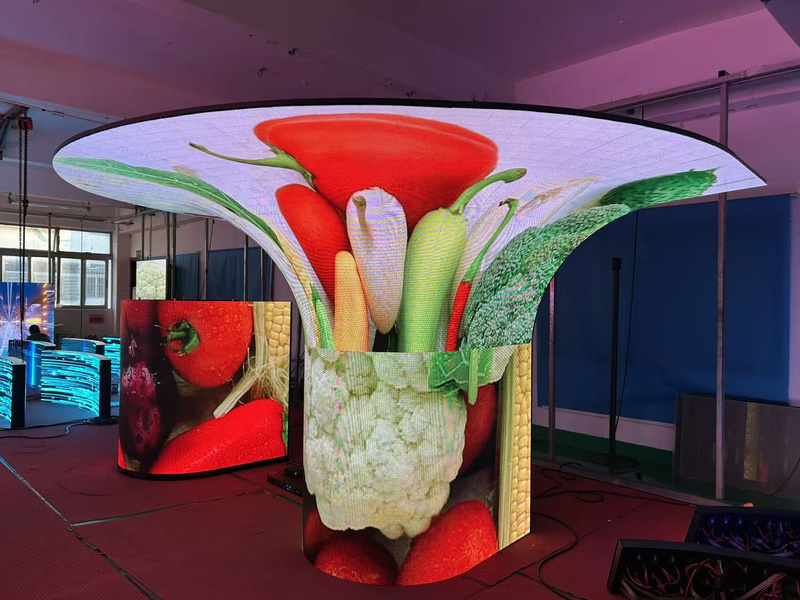
During APEC 2026 in Shenzhen, international business leaders are discussing trade cooperation, advanced manufacturing and technological innovation. These topics also reflect an important concern in the LED display industry: how manufacturers can deliver reliable products for different markets and project requirements.
For custom-shaped LED displays, product quality starts long before the screen is switched on.
Cabinet dimensions, frame accuracy and connection positions all affect the final installation. Even a small dimensional error can create uneven gaps or alignment problems when multiple cabinets are connected.
Before assembly, checking cabinet squareness is an important step. Measuring both diagonals is a simple way to identify possible structural deviations in rectangular cabinet sections.
A cabinet may have the correct width and height but still be slightly twisted.
When this happens, the four corners may not form accurate right angles. The problem may be difficult to notice when inspecting one cabinet alone.
However, after several cabinets are connected, small errors can become more visible.
Common problems include:
For large custom-shaped LED displays, these problems can affect both the appearance and installation process.
Several factors can affect cabinet geometry during manufacturing and transportation.
Frame machining errors
Incorrect hole positions or inaccurate cutting dimensions can affect the relationship between the four corners.
Uneven welding
Heat during welding may cause slight structural deformation if the frame is not properly controlled.
Assembly pressure
Over-tightening screws or fixing one corner before aligning the entire frame may create unwanted stress.
Transportation damage
Pressure on one side of a cabinet during packing or transportation may cause deformation.
Incorrect installation
Forcing two cabinets together when their connection points do not match can transfer the alignment problem to neighboring sections.
Identifying these issues before final assembly helps reduce unnecessary adjustments.
A diagonal measurement check is straightforward. It should be performed on a stable, flat inspection surface.
Step 1: Check the basic dimensions
Measure the cabinet width at the top and bottom. Then measure the height on both sides.
Record the results and compare them with the approved technical drawing.
Step 2: Measure the first diagonal
Measure from the upper-left corner to the lower-right corner.
Record this as Diagonal A.
Step 3: Measure the second diagonal
Measure from the upper-right corner to the lower-left corner.
Record this as Diagonal B.
Step 4: Compare the results
For a rectangular cabinet, the two diagonal measurements should be almost identical.
For example:
This difference should be recorded and checked against the project’s agreed manufacturing tolerance.
There is no single tolerance suitable for every cabinet. The acceptable deviation depends on cabinet dimensions, structural design and installation requirements.
Important: For trapezoidal, triangular, curved or other irregular cabinets, equal diagonals are not necessarily the correct standard. Their dimensions and angles must be checked against the approved CAD drawings and specified reference points.
Checking one cabinet is not enough for projects that require accurate alignment across a large screen.
A trial assembly using several cabinets can help identify repeated dimensional errors.
Place three to five cabinets on a suitable reference frame and connect them without applying excessive force.
Then check:
A straightedge, measuring tape, angle gauge or laser measuring tool can help with these checks.
If the alignment gradually changes across several cabinets, inspect each cabinet individually to identify the source of the deviation.
For custom-shaped LED displays, accurate assembly depends on more than one measurement.
The frame structure, module dimensions, mounting holes and connection positions must all match the approved design.
At TOOSLED, custom LED display projects cover different shapes and structures, including spherical, curved, cylindrical and other irregular designs.
Our product development and manufacturing process considers the intended application, screen dimensions and installation environment.
Important manufacturing and inspection steps include:
TOOSLED’s published manufacturing information also highlights material inspection and continuous aging tests as part of its quality control process.
These steps help identify potential problems before products reach the installation site.
Consider a commercial project that requires a curved LED display along a retail wall.
The design uses several customized cabinet sections to follow the shape of the installation space.
During pre-assembly, the production team checks the dimensions and connection positions of each cabinet. Rectangular reference sections are checked through diagonal measurements, while curved and irregular sections are compared with their approved design drawings.
After the initial inspection, several cabinets are connected for a trial assembly.
This process helps identify possible gaps, structural deviations and connection problems before packing.
For customized projects, early inspection is often more efficient than correcting alignment problems after installation.
Q1: Why should both cabinet diagonals be measured?
Because checking width and height alone does not confirm that a rectangular cabinet is square. Comparing both diagonals helps identify geometric deviations.
Q2: Do all custom-shaped LED cabinets need equal diagonals?
No. Equal diagonals are a useful check for rectangular structures. Irregular shapes must be inspected according to their approved drawings and design dimensions.
Q3: Can cabinet squareness problems be corrected through software calibration?
No. Software calibration can adjust brightness and color, but it cannot correct physical frame deformation or incorrect cabinet dimensions.
Q4: When should diagonal measurements be checked?
They should be checked after cabinet assembly and before final screen assembly or shipment. For customized projects, additional checks during trial assembly are also recommended.
Q5: Can TOOSLED provide customized LED display cabinets?
Yes. TOOSLED develops custom LED display solutions in different shapes, sizes and pixel pitches according to project requirements. Customers can provide drawings, 3D models or reference images for technical evaluation.
A good custom LED display starts with accurate design and careful manufacturing.
From cabinet dimensions and structural connections to module alignment and final testing, every stage can affect the finished screen.
TOOSLED is a Shenzhen-based LED display manufacturer established in 2014. The company focuses on LED display research and development, manufacturing and customized solutions.
Our product range includes spherical LED displays, special-shaped LED displays, indoor LED displays and outdoor LED displays.
For overseas distributors, engineering contractors and commercial project developers, we offer opportunities to discuss customized product designs, OEM/ODM cooperation and different project requirements.
We also welcome customers to visit our Shenzhen factory and learn more about our products and manufacturing process.
If you are planning a custom-shaped LED display project, contact TOOSLED to discuss your drawings, cabinet dimensions and installation requirements.
TOOSLED — Your Manufacturing Partner for Creative LED Display Solutions.
+86 18688923792
+86-755-23312336
4th Floor, Building B, Zhonghe Building, Taiwan Industrial Zone, 2132 Songbai Road, Shiyan Street, Bao'an District, Shenzhen.


Emall us with any questions or inquiries or use our contact data.We would be happy to answer your questions.
Toosen Professional Manufacturer of led sphere display,led screen globe,led ball display,spheric led screen,spherical led display, Led Special-shaped LED manufacturer, LED factory,Manufacturers & Suppliers,Factory & Exporters. Looking forward to your cooperation.
Copyright © 2010-2026 Toosen LED All Rights Reserved
Theme by WordPress