-
English


Large shaped LED displays are becoming popular in shopping malls, exhibition halls, entertainment venues, and commercial spaces. Unlike standard flat LED screens, custom-shaped video walls may include curved surfaces, cylinders, spheres, and irregular structures.
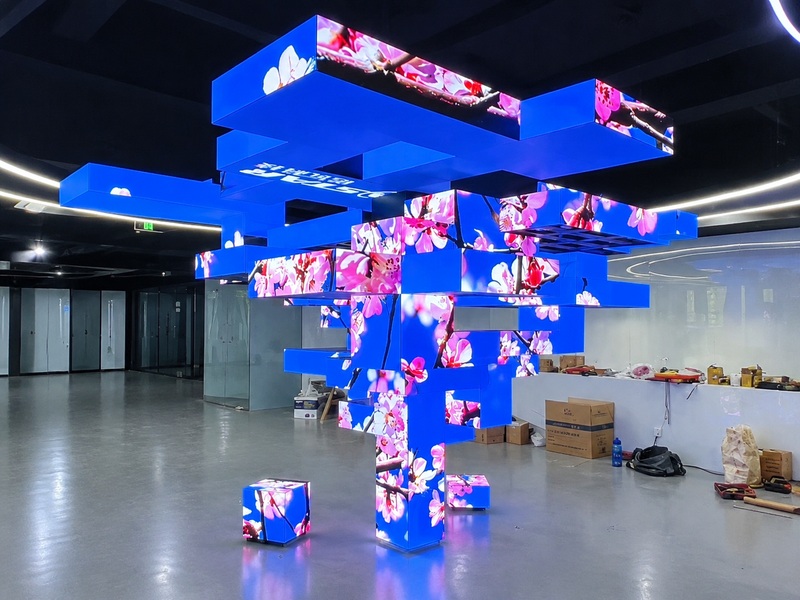
However, as screen size increases, power distribution becomes an important part of project planning. A large LED video wall needs enough electrical capacity to support all modules, power supplies, and control equipment.
If the electrical system is not properly designed, the display may experience voltage drops, circuit overloads, unexpected shutdowns, or unstable performance.
So, how can project engineers calculate the electrical requirements for a large shaped LED display before installation?
A large shaped LED display may contain hundreds or thousands of LED modules. Each module requires a stable power supply, and all modules must work together.
Poor power distribution can cause several problems:
For commercial projects, these problems can delay installation and increase maintenance costs. Therefore, power planning should be completed before the display structure is assembled.
Before calculating power requirements, engineers should collect several basic specifications.
Screen size: The total display area is the starting point for estimating power consumption.
Maximum power consumption: This indicates the highest electrical demand under specified operating conditions. It is important for selecting circuit capacity and protective devices.
Average power consumption: Actual consumption during normal content playback is usually lower than maximum consumption.
Input voltage: The electrical supply must match the power supply specifications. Many LED display systems support AC input within a specified voltage range.
Cable length: Longer cables can create greater voltage drops, especially when the current is high.
For shaped LED displays, the power distribution layout also depends on the screen structure. Curved and irregular designs may require different cable routes and power connection points.
The basic calculation starts with the display area and power consumption per square meter.
Step 1: Calculate the total display area
For a rectangular screen:
Total Area = Screen Width × Screen Height
For example, a video wall measuring 8 meters wide and 2.5 meters high has a total area of:
8 × 2.5 = 20 m²
For irregular displays, engineers should use the actual LED module layout or the manufacturer’s confirmed effective display area.
Step 2: Calculate maximum power consumption
Maximum Power = Total Display Area × Maximum Power per Square Meter
Assume the selected display specification lists a maximum power consumption of 800W/m².
20 × 800 = 16,000W
The estimated maximum power demand is therefore 16kW.
This is an example calculation. The actual value must come from the selected product’s technical datasheet.
Step 3: Calculate the required current
For a single-phase AC supply, a simplified calculation is:
Current (A) = Power (W) ÷ Voltage (V)
At 230V:
16,000 ÷ 230 ≈ 69.6A
This is an approximate calculation. For a practical installation, engineers must also consider power factor, efficiency, supply conditions, and applicable electrical regulations.
Step 4: Allow sufficient electrical capacity
The electrical distribution system should not operate continuously at its absolute limit.
For preliminary planning, a 20% capacity allowance can be used as an example:
16kW × 1.2 = 19.2kW
This allowance is not a universal electrical-code requirement. The final circuit ratings and protection settings must be determined by a qualified electrical engineer.
After estimating total power demand, the next step is to divide the display into suitable power zones.
For example, a large video wall may be divided into several sections, with each section receiving power from a dedicated distribution branch.
A good distribution plan should consider:
For shaped LED displays, engineers should also consider the physical structure. A cylindrical or curved screen may need power cables routed through different sections to avoid interference with structural components.
Clear cable labeling also makes future maintenance easier.
Calculating total power is not enough. Engineers must also verify that electricity can reach every part of the screen safely.
Long cable runs may cause voltage drops, while overloaded connections can generate excessive heat.
Before installation, check the following:
The allowable voltage drop should follow the applicable electrical standards and equipment requirements.
These tests help identify potential problems before the display enters regular operation.
A complete shaped LED display power system normally includes:
The power supply capacity must match the actual module configuration. Engineers should also check the output voltage, rated current, efficiency, and operating temperature.
TOOSLED provides customized shaped LED displays in different pixel pitches and structures. Depending on project requirements, customers can choose curved, spherical, cylindrical, and other irregular display designs.
You can explore the TOOSLED Shaped LED Display product range when planning a customized video wall.
Consider a shopping mall project requiring a 20m² custom-shaped LED video wall.
The engineering team first confirms the maximum power consumption from the selected product datasheet. Assuming 800W/m², the estimated maximum demand is 16kW.
The team then plans separate power branches for different display sections, checks cable distances, and confirms the available building supply.
Before delivery, the electrical layout is reviewed together with the screen structure and installation drawings.
After installation, technicians test the voltage under load, inspect connections, and operate the entire screen at different brightness levels.
This process helps reduce electrical risks and makes future maintenance more manageable.
Q1: Should I use maximum or average power consumption when planning circuits?
Use maximum power consumption as the main reference for electrical capacity planning. Average consumption is more useful for estimating normal operating costs.
Q2: How many power circuits does a large LED video wall need?
There is no fixed number. It depends on total power demand, circuit ratings, voltage, cable length, and local electrical regulations.
Q3: Does a shaped LED display need a different power distribution design?
It may. Curved, spherical, and irregular structures can require different cable routes and power connection positions.
Q4: Can voltage drops affect LED display brightness?
Yes. Excessive voltage drops can cause unstable operation, especially when power cables are long or connections are poorly designed.
Q5: What information should buyers provide before requesting a power distribution plan?
Provide screen dimensions, shape drawings, pixel pitch, product datasheets, installation location, available input voltage, and estimated cable distances.
Power distribution planning should be considered together with screen design, module arrangement, cabinet structure, and installation conditions.
TOOSLED specializes in customized LED display solutions, including spherical screens and other special-shaped LED displays. The company supports OEM and ODM projects, with different pixel pitches, screen dimensions, and structural designs.
Before production, customers can provide drawings or project requirements for technical evaluation. This helps the engineering team consider product configuration, installation structure, and electrical connection requirements at an early stage.
With product customization and technical support, TOOSLED helps customers prepare their LED display projects from design through installation.
For a large shaped LED video wall, proper power distribution planning is not just a technical detail. It is an important step toward safe installation, stable operation, and long-term display performance.
+86 18688923792
+86-755-23312336
4th Floor, Building B, Zhonghe Building, Taiwan Industrial Zone, 2132 Songbai Road, Shiyan Street, Bao'an District, Shenzhen.


Emall us with any questions or inquiries or use our contact data.We would be happy to answer your questions.
Toosen Professional Manufacturer of led sphere display,led screen globe,led ball display,spheric led screen,spherical led display, Led Special-shaped LED manufacturer, LED factory,Manufacturers & Suppliers,Factory & Exporters. Looking forward to your cooperation.
Copyright © 2010-2026 Toosen LED All Rights Reserved
Theme by WordPress