-
English


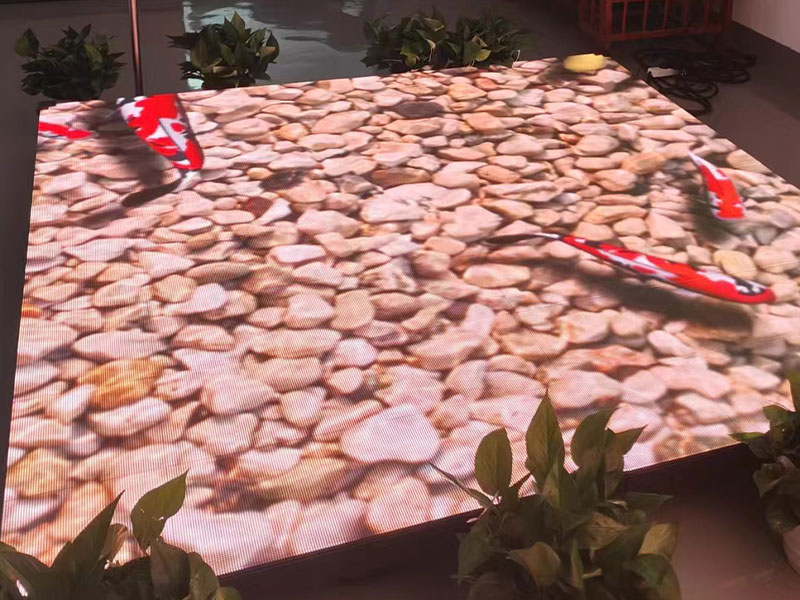
In recent years, LED floor screens have grown fast across the global market. They appear in exhibition halls, concerts, shopping malls, dance floors, and immersive spaces. Their strong visual impact and interactive effects attract both audiences and investors.
Market data shows that the global interactive LED floor screen market reached about USD 352 million in 2024. From 2025 to 2031, the market is expected to grow at a high compound rate. This trend proves one thing clearly. LED floor screens are no longer niche products. How can floor tile LED screens boost brand promotion?
However, many people still think an LED floor screen is just a traditional LED screen placed on the ground. This idea is incorrect.
In fact, the construction process and installation time are very different. This article explains those differences clearly, step by step.
Traditional LED screens usually mount on walls or hang from structures. They do not touch the ground. Their main concerns include weight loading on walls, wind resistance, and viewing angles.
LED floor screens work in a completely different way. People walk on them. Sometimes vehicles pass over them. This creates high pressure and long-term stress.
Because of this, LED floor screens require stronger structures, better foundations, and longer installation time.
Load-bearing design is the biggest difference between the two screen types.
Traditional LED screens focus on suspension safety. LED floor screens focus on pressure resistance and surface stability.
The table below shows a clear comparison.
| Stage | Traditional LED Screen (Wall-Mounted / Hanging) | LED Floor Screen (Ground-Installed) |
|---|---|---|
| Load Evaluation | Evaluate wall or steel structure load capacity, flatness, and installation space (such as hanging height) | Evaluate ground load capacity (pedestrians or vehicles), flatness, moisture resistance, waterproofing, and drainage slope |
| Foundation Work | Build steel support structure for wall or hanging installation, no ground modification needed | Ground foundation treatment (key step): • Indoor: floor leveling (≤2mm error per m²), shock pads to avoid noise, moisture barrier • Outdoor: concrete foundation (≥500kg/m²), drainage slope design (1%–3%), waterproof coating (IP67 standard) |
| Product Preparation | Standard cabinet design, no special structure needed | Customized floor design: • Reinforced cabinets (aluminum alloy or steel) • Locking system to prevent movement • Anti-slip surface (frosted or textured panels) • Bottom heat dissipation channels |
Installation time is another major difference.
Traditional LED screens install faster. Once the first row is aligned, the rest follow easily. Gravity works in your favor.
LED floor screens do not work that way.
Each panel must sit on the same horizontal level. Installers must adjust support feet one by one. Precision matters.
If one panel sits higher, people feel a “kick” when walking.
If one panel sits lower, pressure becomes uneven. Over time, this can cause frame damage or dead pixels.
Because of this, LED floor screen installation always takes more time.
Traditional LED Screen
The process is simple. Installers check wall strength. Then they weld or fix a steel frame. After that, the screen is ready for mounting.
LED Floor Screen
This step is much more complex. The ground must be perfectly flat.
If the height difference exceeds 10mm, installers must first level the floor. They may use self-leveling materials or adjustable high-density supports. Every joint must align on a perfect plane.
Traditional LED Screen
The steps are clear and fast:
LED Floor Screen
The steps are more detailed:
Each step affects long-term safety and display quality.
Heat control is another key issue.
LED floor screens lie flat on the ground. Heat naturally rises. However, protective panels block airflow. Heat can build up between the module and the cover.
To solve this, most LED floor screens use aluminum cabinets.
Aluminum transfers heat faster than steel. It moves heat away from the LED modules to the back of the cabinet. Heat then releases through cooling fins or channels.
This design protects the LEDs and ensures stable performance during long operation hours.
Indoor LED floor screens focus more on:
Outdoor LED floor screens focus more on:
Outdoor projects often require concrete foundations. They also require IP67-level protection. This adds time and cost, but it ensures long-term safety.
Even though LED floor screens take longer to build, they offer clear advantages.
They create strong visual impact.
They support interaction and immersion.
They turn passive viewers into active participants.
This explains why museums, exhibitions, and events increasingly choose LED floor screens over traditional displays.
LED floor screens and traditional LED screens differ greatly in construction process and installation time. LED floor screens require stronger foundations, higher precision, and more careful planning.
They are not simple displays. They are closer to a ground construction project.
However, the results justify the effort. With correct design and installation, LED floor screens deliver durability, safety, and stunning visual effects.
For projects that demand interaction and immersion, LED floor screens are a powerful solution.
1. Why does an LED floor screen take longer to install than a traditional LED screen?
Because each panel must be level and load-balanced. Ground foundation work and precise height adjustment take more time.
2. Can LED floor screens support heavy loads?
Yes. With reinforced cabinets and proper foundation design, LED floor screens can support pedestrians and even vehicles.
3. Are LED floor screens suitable for outdoor use?
Yes. Outdoor models use concrete foundations, drainage systems, and IP67 waterproof protection to ensure safe operation.
+86 18688923792
+86-755-23312336
4th Floor, Building B, Zhonghe Building, Taiwan Industrial Zone, 2132 Songbai Road, Shiyan Street, Bao'an District, Shenzhen.


Emall us with any questions or inquiries or use our contact data.We would be happy to answer your questions.
Copyright © 2010-2025 Toosen LED All Rights Reserved
Theme by WordPress