-
English


Building a hemisphere LED screen requires a combination of advanced structural engineering, custom electronics, and specialized video processing technology. Since standard LED modules are flat, manufacturers must overcome significant mechanical and visual challenges to create a smooth curved surface.
The process typically involves three key elements: custom-shaped LED modules, precision structural design, and intelligent control systems.
The biggest challenge in building a hemisphere LED display is transforming flat LED panels into a curved structure.
Traditional rectangular modules cannot form a smooth sphere without creating large gaps between panels. To solve this problem, manufacturers design custom PCB boards in shapes such as triangles, trapezoids, hexagons, or other geometric forms.
Engineers then assemble these modules like pieces of a puzzle, gradually forming the curved surface of the hemisphere.
Because pixel spacing changes slightly across different areas of the curved surface, the system must apply pixel compensation algorithms to maintain image accuracy and prevent distortion.
Every hemisphere LED display starts with a precision-engineered steel or aluminum framework.
The frame must match the intended curvature with millimeter-level accuracy. Even small deviations can create visible gaps, uneven surfaces, or installation difficulties.
For large hemispherical displays, manufacturers often incorporate front-service access, allowing technicians to remove and maintain modules from the front without dismantling the structure.
In areas with moderate curvature, manufacturers may use flexible LED modules.
These modules feature flexible PCB boards and silicone backing materials that allow them to bend and conform to curved surfaces.
Strong magnetic mounting systems enable installers to attach the modules directly to curved metal cabinets, creating a smooth and continuous appearance.
Unlike conventional LED screens that use straightforward horizontal and vertical wiring layouts, hemisphere displays require radial or circular cable routing.
As a result, engineers must customize:
Since the internal space of a hemisphere structure is often limited, many projects use distributed power systems to improve heat dissipation and simplify cable management.
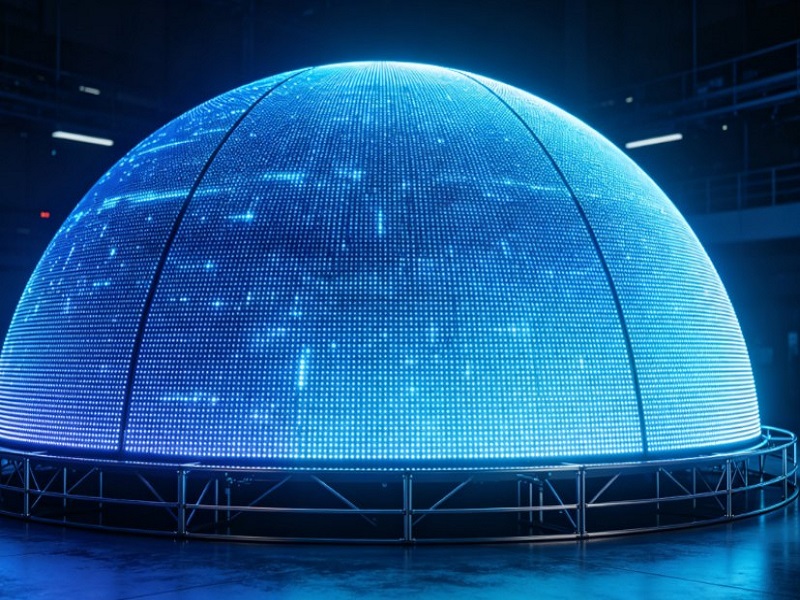
The control system acts as the brain of the hemisphere LED screen.
Without advanced image processing, content designed for flat displays would appear stretched and distorted on a curved surface.
Most video content originates in a 2D format. Before playback, the processor converts the image coordinates and maps them onto the 3D hemispherical surface.
This process ensures that graphics, text, and animations appear visually correct from the audience’s viewing position.
A hemisphere display may contain thousands of LEDs spread across modules of different shapes and sizes.
The control system synchronizes every module at the millisecond level to maintain smooth motion, accurate color reproduction, and seamless playback.
Even with highly precise manufacturing, small physical gaps between modules are unavoidable.
To minimize their visibility, modern control systems use edge-blending and brightness compensation technologies. These adjustments help create the appearance of a continuous surface and reduce visible seams.
| Type | Features | Typical Applications |
|---|---|---|
| Internal Hemisphere Display | Viewers stand inside the structure and watch content projected around them. | Planetariums, flight simulators, immersive theaters, theme parks |
| External Hemisphere Display | Viewers observe the display from the outside, creating the appearance of a glowing digital planet. | Science museums, shopping malls, exhibitions, architectural landmarks |
The primary challenge in manufacturing a hemisphere LED screen is transforming flat electronic components into a seamless curved display. Achieving this requires custom-shaped LED modules, precision structural engineering, specialized wiring systems, and advanced video mapping technology.
When all of these elements work together, a hemisphere LED display can deliver a striking visual experience that combines engineering precision with immersive digital storytelling.
+86 18688923792
+86-755-23312336
4th Floor, Building B, Zhonghe Building, Taiwan Industrial Zone, 2132 Songbai Road, Shiyan Street, Bao'an District, Shenzhen.


Emall us with any questions or inquiries or use our contact data.We would be happy to answer your questions.
Toosen Professional Manufacturer of led sphere display,led screen globe,led ball display,spheric led screen,spherical led display, Led Special-shaped LED manufacturer, LED factory,Manufacturers & Suppliers,Factory & Exporters. Looking forward to your cooperation.
Copyright © 2010-2026 Toosen LED All Rights Reserved
Theme by WordPress