-
English


In most cases, yes — indoor fixed LED displays require a support structure or steel frame.
The exact structure depends on the installation method, screen size, weight, and wall condition.
Even installations that appear to be “direct wall-mounted” usually still rely on metal brackets, steel frames, or mounting rails to support the screen safely.
Only very small LED displays, such as a single module or ultra-light mini screen, may attach directly to a wall. However, this is not considered a standard fixed LED installation.
| Installation Method | Structure Requirement | Typical Applications |
|---|---|---|
| Wall-Mounted | Requires expansion bolts and steel frame made from angle iron or square tubing | The most common solution for concrete or solid walls |
| Recessed Installation | Requires pre-embedded steel structure and maintenance access frame | Conference rooms, exhibition halls, luxury interiors |
| Suspended Installation | Requires hanging rods, steel cables, or truss systems | Shopping malls, transportation hubs, high-ceiling spaces |
| Floor-Standing Installation | Requires floor base support or independent frame | Trade shows, temporary events, exhibition displays |
| Column-Mounted Installation | Requires vertical columns and rear support structure | Stage backdrops and standalone advertising displays |
LED displays are heavy.
Most indoor fixed LED screens weigh approximately 25–60 kg per square meter, while fine-pitch LED screens can weigh even more.
Because of this weight, installers cannot safely mount the screen directly onto drywall, hollow brick walls, or lightweight partitions. A steel structure distributes the load evenly and improves safety.
A properly welded steel frame — usually made from 40×40 mm or 40×20 mm square steel tubing — keeps the installation surface perfectly flat.
This is extremely important because uneven structures can cause:
A stable structure ensures seamless cabinet splicing and better visual performance.
Medium and large fixed LED displays require maintenance space, especially for rear-maintenance designs.
Typically, installers reserve:
Without a proper steel framework, technicians cannot safely access the rear components for repair or replacement.
Not all walls can support an LED screen directly.
The following wall types usually require additional reinforcement:
In these cases, installers often choose:
This prevents wall deformation or installation failure over time.
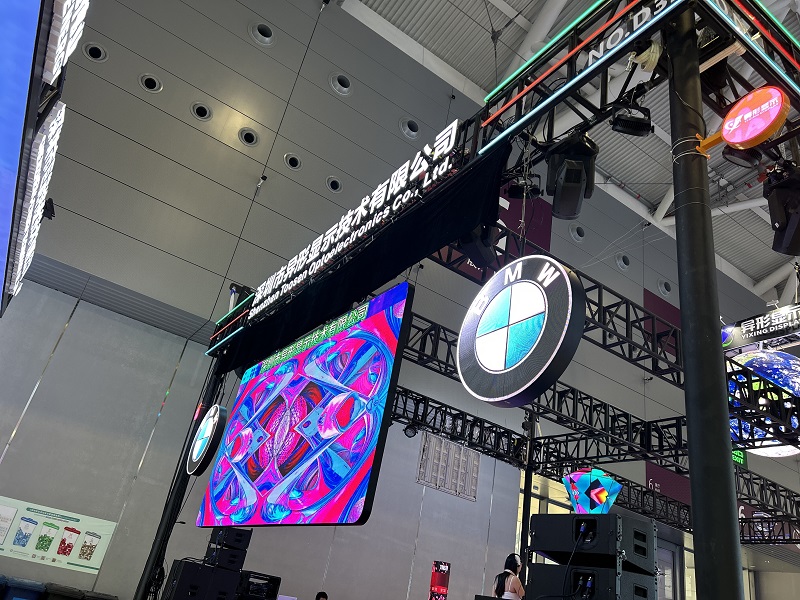
For very small indoor LED screens — typically under 6㎡ and with relatively low total weight — installers may use expansion bolts and mounting brackets directly on a solid concrete wall.
However, metal mounting components are still necessary.
Many fine-pitch LED displays use magnetic modules for easier maintenance.
In this design:
The magnets only secure the modules to the structure; they do not replace the support system itself.
Before installing an indoor fixed LED screen, always:
Concrete walls and steel structures are ideal. Lightweight walls usually require reinforcement.
Formula:
Total Load = Screen Area × Unit Weight
Remember to include:
Proper maintenance access improves long-term reliability and reduces repair difficulty.
Professional structural design and installation greatly improve safety, flatness, and overall display performance.
Toosen has 12 years of experience manufacturing customized LED display solutions for indoor and outdoor applications.
Toosen provides:
With professional engineering support and reliable manufacturing, Toosen helps customers complete LED display installations safely and efficiently.
+86 18688923792
+86-755-23312336
4th Floor, Building B, Zhonghe Building, Taiwan Industrial Zone, 2132 Songbai Road, Shiyan Street, Bao'an District, Shenzhen.


Emall us with any questions or inquiries or use our contact data.We would be happy to answer your questions.
Toosen Professional Manufacturer of led sphere display,led screen globe,led ball display,spheric led screen,spherical led display, Led Special-shaped LED manufacturer, LED factory,Manufacturers & Suppliers,Factory & Exporters. Looking forward to your cooperation.
Copyright © 2010-2026 Toosen LED All Rights Reserved
Theme by WordPress