-
English


Curved LED walls appear frequently in virtual production studios, broadcast sets, exhibitions, and immersive retail environments. Their curved structure surrounds the audience or camera, which creates a stronger sense of depth and immersion than a flat LED wall.
However, many buyers and system integrators encounter a common challenge during the planning stage: how do you calculate the size and radius of a curved LED wall?
The answer involves understanding arc geometry, cabinet angles, and screen dimensions. Once you know how these factors interact, you can design a curved LED wall that fits the space and delivers the intended visual effect.
A curved LED wall essentially forms part of a circular arc. Three key values define that arc:
These parameters follow the classic arc-length relationship:
L=Rθ
Where:
With this formula, designers can calculate the curvature needed for a specific installation.
Start by defining the screen width, which becomes the arc length in the formula.
For example, a virtual production studio might plan a wall that measures:
In this case:
Arc Length (L) = 12 meters
This measurement represents the total distance across the curved surface of the LED wall.
Next, define the total arc angle. This angle represents how much the LED wall curves around the viewing area.
Common curved LED wall angles include:
For example, if the wall curves 60°, you must convert the value into radians before applying the formula:
60° ≈ 1.047 radians
Once you know the arc length and arc angle, calculating the radius becomes straightforward.
Using the earlier example:
Radius:
R ≈ 11.46 meters
This means the curved LED wall forms part of a circle with a radius of roughly 11.5 meters.
In real installations, LED walls achieve curvature through adjustable cabinet connections rather than continuous bending.
Most LED cabinets allow small angle adjustments, such as:
Each cabinet contributes a small portion of the total curve.
For example:
If each cabinet connects at 3°, and you use 20 cabinets, the wall creates:
20 × 3° = 60° total curvature
This method makes it easier to design and assemble curved LED walls while maintaining structural stability.
To estimate cabinet quantity, divide the total screen width by the width of each LED cabinet.
Example:
Number of cabinets:
12 m ÷ 0.5 m = 24 cabinets
These cabinets then connect with adjustable angles to produce the desired curvature.
Even with accurate calculations, designers should always validate curved LED walls using 3D modeling tools.
Popular tools include:
These tools help engineers:
Early modeling prevents costly structural issues during installation.
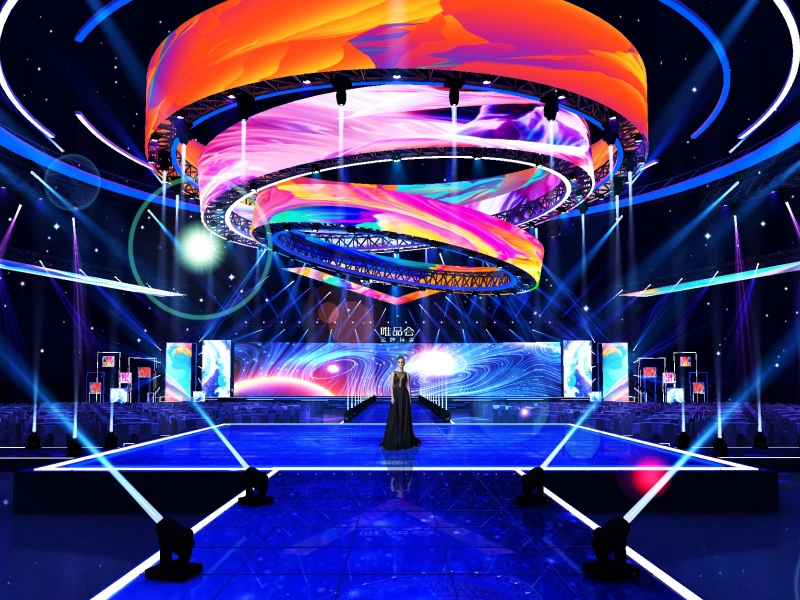
Accurate curvature calculations become especially important in high-end LED installations.
Film and television studios often build curved LED volumes to create realistic digital environments. Proper radius calculations ensure correct camera perspective and lighting reflections.
News and talk show studios use gentle curved LED walls to enhance background visuals while maintaining a wide camera viewing range.
Museums and brand experiences often use large curved displays to surround visitors with interactive content.
Standard LED cabinets work well for moderate curves, but some projects require fully customized structures.
Manufacturers like Toosen specialize in creative LED display solutions, including curved LED walls, spherical LED displays, circular LED screens, and other special-shaped installations. These customized systems combine flexible modules, precision cabinets, and engineered support structures to achieve complex curved designs.
Such solutions allow designers to create immersive environments that traditional flat LED walls cannot achieve.
Calculating the size and radius of a curved LED wall becomes much easier when you follow a structured approach:
With careful planning, curved LED walls can deliver immersive visuals, seamless installation, and optimal viewing angles. As demand grows in virtual production, exhibitions, and commercial spaces, mastering these calculations will help designers build more precise and impactful LED display environments.
+86 18688923792
+86-755-23312336
4th Floor, Building B, Zhonghe Building, Taiwan Industrial Zone, 2132 Songbai Road, Shiyan Street, Bao'an District, Shenzhen.


Emall us with any questions or inquiries or use our contact data.We would be happy to answer your questions.
Copyright © 2010-2026 Toosen LED All Rights Reserved
Theme by WordPress