-
English


A customized LED display may run normally for hours after it is switched on, yet the circuit breaker trips almost every time the system starts.
This situation can be confusing.
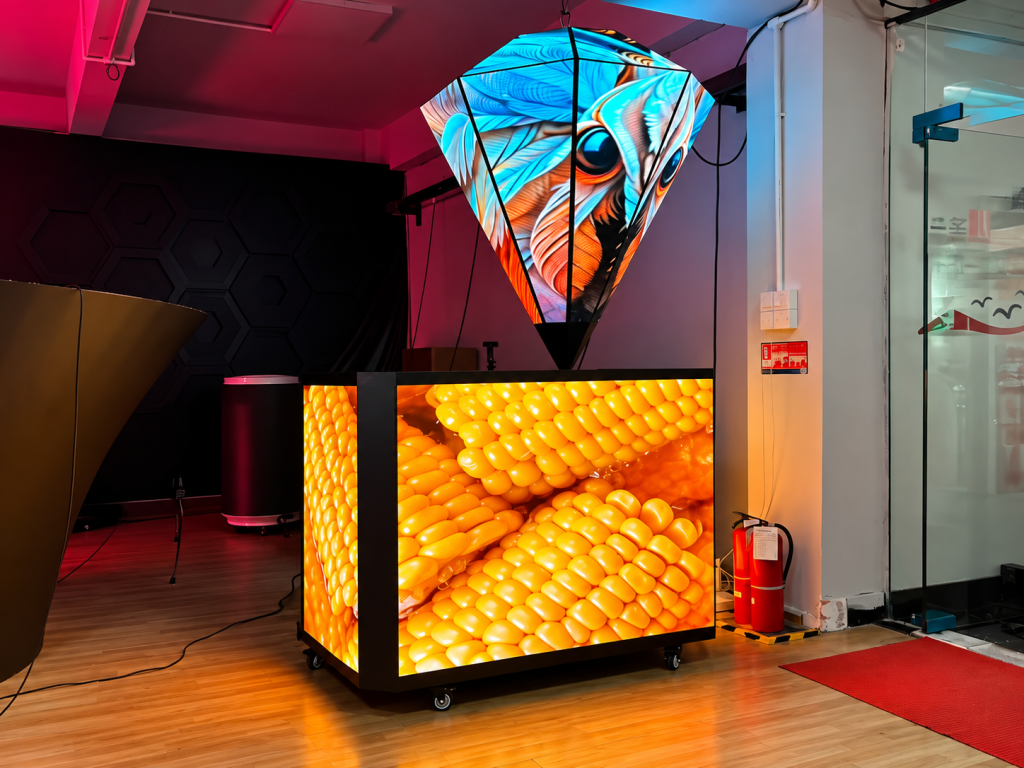
The electrician measures the display after startup and finds that the current is well below the breaker rating. The cables are not overheating. The screen works normally once power is restored. However, the next cold start causes another trip.
The problem is often not the normal running power.
It is the startup inrush current created during the first moment of power-on.
LED displays use many switching power supplies.
When the screen is already operating, these power supplies deliver relatively stable DC power to LED modules, receiving cards, fans and other components.
For example, a display may operate continuously at only 40–60% of the capacity of its electrical circuit.
But startup is different.
Inside each LED power supply are capacitors that must charge when AC power is first connected. For a very short period, the power supply may draw much more current than it uses during normal operation.
One power supply normally does not create a serious problem.
A customized LED display, however, may contain dozens or even hundreds of power supplies.
If all of them start at exactly the same moment, their temporary current peaks overlap.
The breaker sees that combined peak instead of the normal operating load.
The problem can be more noticeable in a customized LED display than in a standard flat LED wall.
Irregular screens often have unusual power distribution layouts.
A sphere may divide power supplies between several internal sections. A long curved display may have multiple power branches following the frame. Letter-shaped or architectural LED displays may contain many small power groups distributed across different positions.
During design, engineers may correctly calculate total wattage but overlook how many power supplies are connected to one branch.
For example:
Their normal running currents may all remain acceptable.
But Branch C may still trip at startup because too many power supplies energize simultaneously.
This is why breaker sizing should not be based only on average or normal operating power.
Inrush current is common, but engineers should not immediately assume it is the only cause.
Startup tripping may also come from:
Incorrect breaker selection
Different breaker trip characteristics react differently to short current peaks. A breaker selected only according to continuous current may react too quickly during LED screen startup.
Too many power supplies on one circuit
The total screen power may be reasonable, but individual circuits may be poorly balanced.
Long or undersized AC cables
Voltage drop during startup can make the electrical system less stable.
Loose terminals
A loose connection can create heating, voltage fluctuation or abnormal electrical behavior.
Leakage current accumulation
Many switching power supplies connected together can produce combined leakage current. This becomes especially important when residual-current protection devices are involved.
Therefore, repeatedly replacing the breaker with a larger one without testing the system is not a good diagnostic method.
One effective solution for large customized LED displays is sequential power distribution.
Instead of supplying power to every section simultaneously, the screen is divided into several electrical groups.
For example:
Group 1 → power on
Wait 0.5–1 second
Group 2 → power on
Wait 0.5–1 second
Group 3 → power on
The complete startup may take only several seconds, but the power supplies no longer create one large combined current peak.
For installations using a power distribution cabinet, contactors or programmable power controllers can automate this process.
This method is especially useful for large spherical screens, curved LED structures and other customized displays containing many independent power supplies.
Before changing breakers or cables, technicians can perform a basic isolation test.
First, switch off all LED display power branches.
Then energize only one section.
Record whether the breaker remains stable.
Next, add another section and repeat the test.
Continue until either the complete screen is operating or the trip occurs.
If every group starts normally by itself but the breaker trips when all groups start together, simultaneous inrush current becomes a strong suspect.
Technicians can then test a staggered startup sequence.
A clamp meter with inrush-current measurement is even more useful. Compare:
Startup peak current → normal full-screen operating current
Do not record only the current several seconds after startup. By then, the temporary surge may already have disappeared.
This test provides much more useful information than simply saying, “The screen uses only 12 amps when running.”
Electrical testing should be completed before shipment whenever possible.
For customized LED display projects, our engineers can check:
The restart test is important.
A display that operates normally after one successful startup has not necessarily passed the electrical test.
Technicians should shut the complete screen down, allow the power supplies to discharge, and perform several cold-start tests.
The test should also include full-screen white content or another high-load pattern after startup to confirm that the system remains stable under operating load.
Consider a large curved display divided into six structural sections.
During operation, the measured electrical load is comfortably below the breaker capacity.
However, the main breaker occasionally trips when the complete screen is switched on.
Instead of increasing the breaker size immediately, engineers test each section separately.
All six sections start normally.
When all six are powered simultaneously, the trip returns.
The control logic is then changed so the sections start in pairs with a short delay between each step.
The screen reaches exactly the same final operating power, but the startup peak is distributed over time.
The breaker no longer sees one concentrated surge.
This example shows why running power and startup behavior must be evaluated separately.
Not necessarily. Normal operating current can be within the circuit rating while the short startup current is much higher.
Do not increase the breaker rating without checking cable capacity, power distribution and protection requirements. The breaker must remain correctly matched to the electrical system.
Usually not completely. Brightness mainly affects power consumption after the display begins operating. The initial charging of the power supplies still occurs during startup.
No. Small displays may start normally without it. It becomes more useful as the number of power supplies and electrical branches increases.
For a reliable customized LED display, electrical planning should consider more than maximum wattage.
Engineers should know how many power supplies are connected to each branch, how the circuits are balanced and what happens during the first second after power is applied.
Toosled provides customized LED display solutions including structural design, module configuration, power distribution planning, factory assembly and system testing.
For projects involving spheres, curves, letters or other irregular LED structures, evaluating startup behavior before installation can prevent repeated breaker trips at the final site.
The important question is therefore not only:
“How much power does the LED display use?”
It is also:
“What happens when all of its power supplies start?”
+86 18688923792
+86-755-23312336
4th Floor, Building B, Zhonghe Building, Taiwan Industrial Zone, 2132 Songbai Road, Shiyan Street, Bao'an District, Shenzhen.


Emall us with any questions or inquiries or use our contact data.We would be happy to answer your questions.
Toosen Professional Manufacturer of led sphere display,led screen globe,led ball display,spheric led screen,spherical led display, Led Special-shaped LED manufacturer, LED factory,Manufacturers & Suppliers,Factory & Exporters. Looking forward to your cooperation.
Copyright © 2010-2026 Toosen LED All Rights Reserved
Theme by WordPress